

Westport Wharf Reconstruction
Location: Wesport, Newfoundland and Labrador
Client: Small Craft Harbours, Fisheries and Oceans Canada
Timeframe: 2022-2023
Key Personnel: Doug Power
Project Description
Harbourside was engaged as the primary consultant by the Department of Fisheries and Oceans Canada Small Craft Harbours to complete the planning, design, and contract administration for the reconstruction of the wharf in Westport, Newfoundland. The new wharf was constructed in a similar footprint, with the stem extending one additional crib seaward, then turning approximately 45-degrees towards the inner harbour and continuing for an additional 12.2 meters. The armour stone breakwater remains in a similar position to the original. The new structure is additionally enhanced by an electrical system and jib crane. A new electrical shed provides electrical service to the system, located in the uplands near the wharf stem.
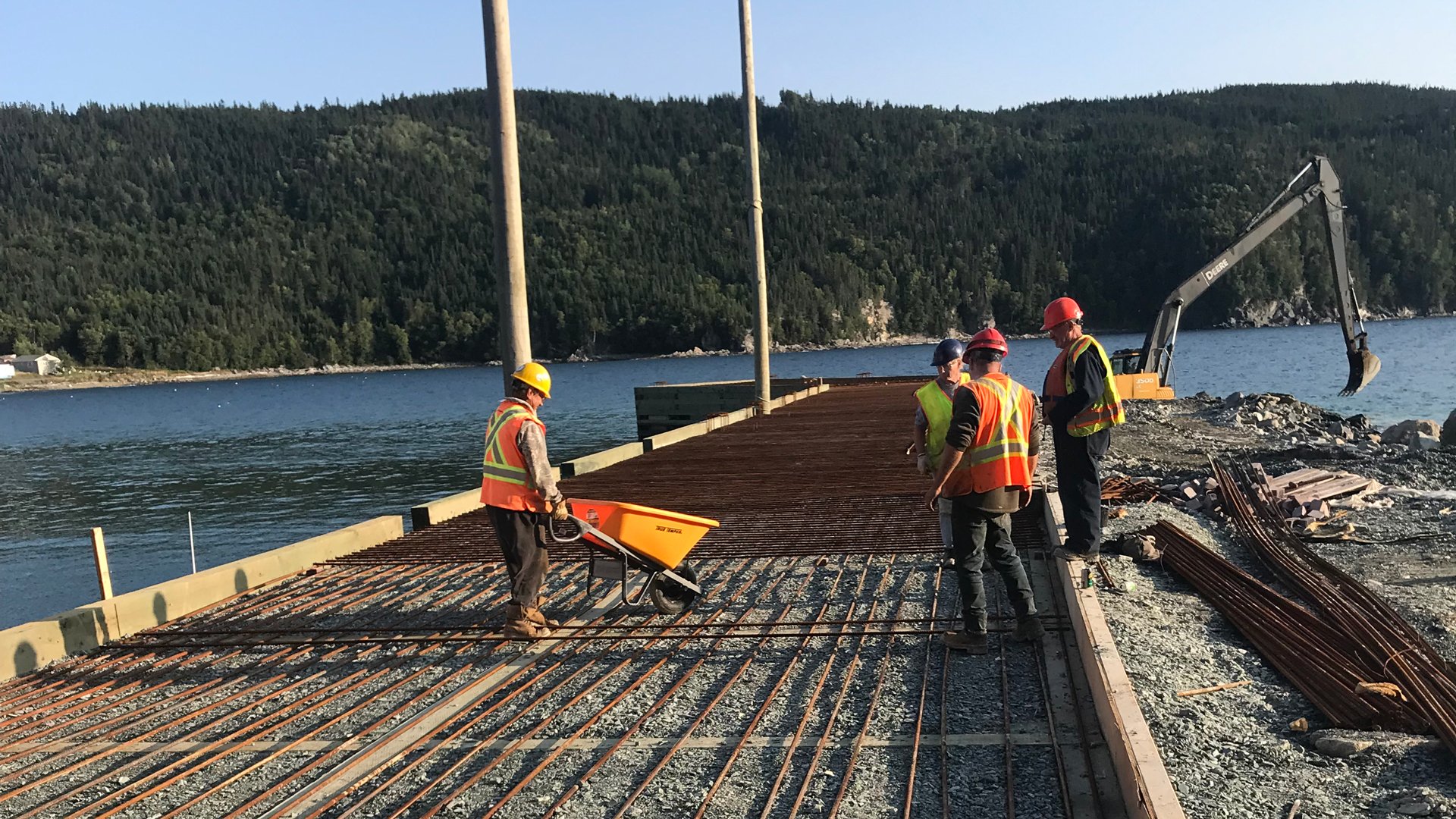
After developing the construction documents, Harbourside provided support during the tender phase by answering technical queries, providing additional information to bidders, and preparing addendums. During construction, Harbourside Engineering had onsite personnel there to oversee construction, including completing inspections and quantity calculations. In addition, Harbourside reviewed progress claims, change orders, shop drawings, answered technical queries and completed additional commissioning and post construction tasks to close out the contract.
Harbourside’s Role
Harbourside Engineering completed the initial inspection of the existing structure, coordinated the electrical scope of work to be completed by a subconsultant. Then, Harbourside proceeded to complete all preliminary and detailed design work and tender preparation (including drawings, specifications, and cost estimate) for the replacement structure. Our firm also provided construction/contract administration services throughout construction, including review of daily and weekly progress reports prepared by Harbourside’s fulltime onsite inspector. Approving contractor progress claims, reviewing shop drawings and other submittals, and resolving technical issues encountered in the field also fell under Harbourside staff purview. These efforts were led by Doug Power, who also completed a site visit following the completion of all major construction works to identify any deficiencies to be addressed by the contractor.
The project involved the replacement of the existing 48m-long timber crib wharf structure at Westport, Newfoundland, with a 70m-long timber structure including the extension of an existing breakwater, detailing to accommodate an existing building on the wharf’s approach, and new electrical pedestals, light fixtures, and jib crane.
Project Challenges & Constraints
One large constraint on the project that had a significant impact throughout both the design and construction phases was ensuring the integrity of the existing buildings adjacent to the project site. The location of the adjacent facilities constrained the geometry of the cribwork. Harbourside worked to combat this challenge in the design phase of the project by incorporating a stepping pattern in the crib seats. By strategically implementing the stepping pattern, Harbourside not only maintained the structural integrity of the adjacent facilities but also optimized the use of available space, ensuring a seamless integration with the surrounding environment. The planning and execution during the design phase allowed for a successful construction process.
Another challenge faced by Harbourside during this project was the unique geometry of the wharf. The approximate 45-degree turn in the wharf’s layout presented a considerable challenge in terms of both design and construction. The geometry had an impact on the detailing of the structure, requiring attention to ensure not only the visual aesthetics but also the structural integrity. Harbourside incorporated additional support bracing to effectively distribute the loads throughout the concrete deck slab and maintain stability around the bend. The breakwater reinstatement also complicated the geometry of the wharf. Because of this, the breakwater design had to be adapted to effectively mitigate wave action and protect the structure. Harbourside adjusted the breakwater’s dimensions and alignment for the modified wharf layout, ensuring that it provided the necessary coastal protection. This approach to both the wharf and breakwater design demonstrates Harbourside’s ability to address complex geometric challenges and deliver marine infrastructure that met both functional and environmental requirements.