

Carmanville Wharf Reconstruction
Location: Carmanville, Newfoundland
Client: Small Craft Harbours, Fisheries and Oceans Canada
Timeframe: 2023
Key Personnel: Doug Power, Stephen Warford
Project Description
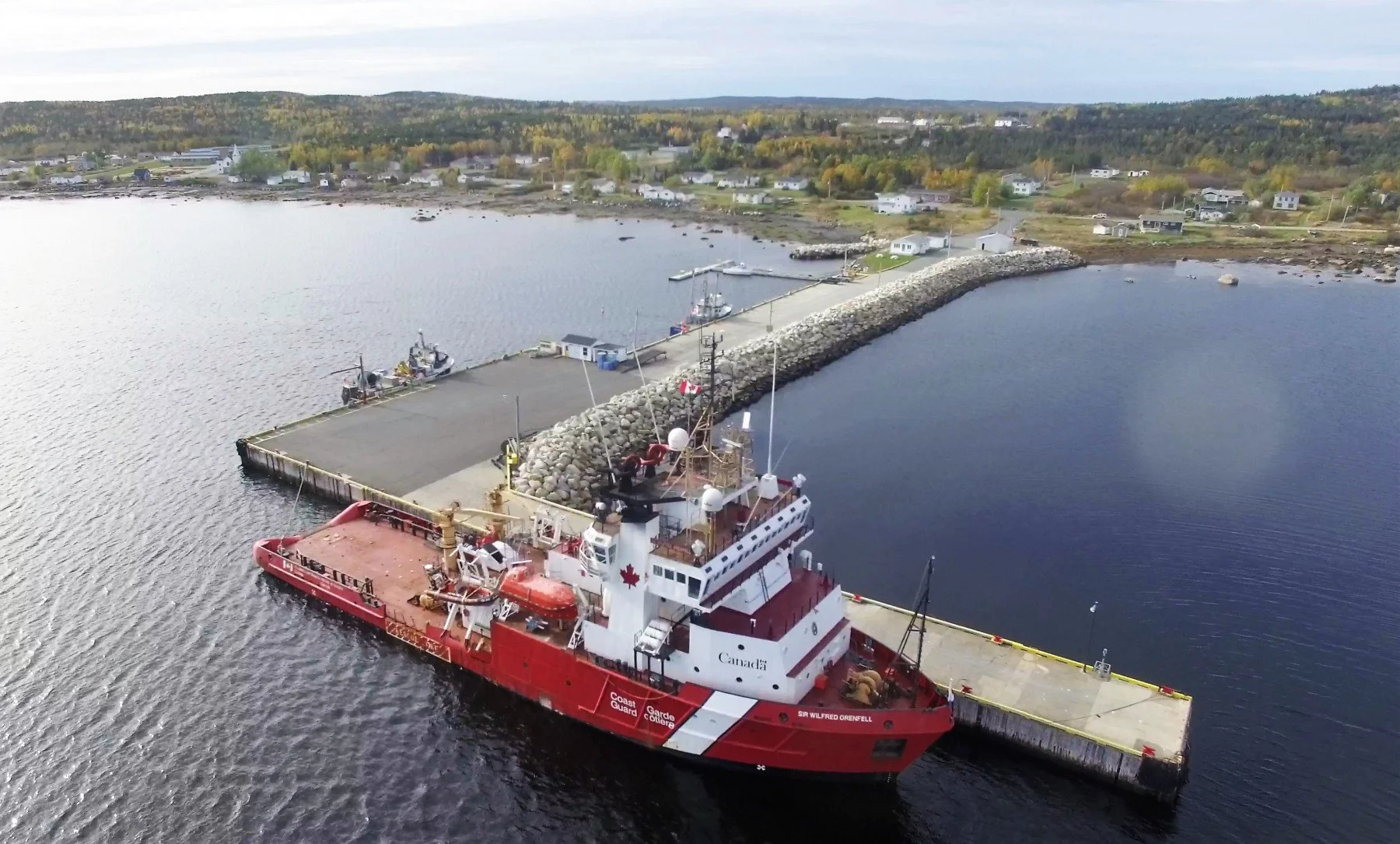
Harbourside was engaged by the Department of Fisheries and Oceans Canada Small Craft Harbours, to develop a tender package to reconstruct the small craft harbour wharf in Carmanville, Newfoundland. This is a very active commercial fishing facility that acts as the Canadian Coast Guard’s primary port for the north coast of Newfoundland. It also accommodates the Argentia Desgagnés, a 119m-long cargo ship which supplies all road salt to the island of Newfoundland. The existing facility is timber cribwork construction consisting of a 175m-long approach causeway, a 61m x 30.5m marginal wharf section (to accommodate fishing vessels) and a 76.25m x 9.15m-wide pier (to accommodate larger vessels). Phase I includes the replacement of the marginal wharf and pier sections of the facility while the planned Phase II (fully designed and ready for tender) will include the replacement of the approach causeway marginal wharf structure.
Scope of Services
Harbourside was engaged to complete the detailed design for the reconstruction of the wharf, a critical facility supporting local fishers, the Canadian Coast Guard, and large cargo vessels. The project involved replacing the existing marginal wharf and pier with a longer and deeper structure to accommodate larger Canadian Coast Guard vessels, upgrading fendering and mooring systems, and raising the deck elevation to address sea level rise. Design elements included new rubber V-fenders, 50-tonne bollards, reinforced concrete anchorages, extension of the breakwater, local dredging, and improved electrical services, cranes, and lighting.
As part of this project, Harbourside undertook a site investigation, coordinated with multiple stakeholders, engaged an electrical subconsultant, and developed the entire tender package for this project. Harbourside also provided technical support throughout the construction of Phase I, reviewing contractor submittals and responding to technical queries arising from the field.
Deliverables, Constraints, & Challenges Overcome
The primary deliverables for this project were interim submissions of contract documents at 33%, 66%, and 100% tender ready packages. The contract document submission included drawings, specifications, capital cost estimates, and schedules.
The provision of bollard and fender systems capable of accommodating vessels much larger than those typically seen at small craft harbour facilities was a notable project challenge. Through consultation with Canadian Coast Guard captains, a mooring line arrangement was developed and incorporated into OPTIMOOR (a mooring analysis software) to accurately estimate mooring loads. Following the completion of Phase I, access and power to the new Phase I wharf must be maintained throughout the Phase II construction which involves the reconstruction of the approach causeway wharf. This has required careful consideration at the Phase II design stage, coordination with the electrical subconsultant, and the utility to develop an underground power supply to Phase I. This must be in service throughout the demolition and reconstruction of the Phase II wharf.
Budget & Schedule Control
Providing the heavy bollard and fender systems described above while keeping the project within the available budget was a considerable challenge. A reinforced concrete cope wall, typically provided for the anchorage of heavy-duty fender systems, could not be accommodated with the available budget. As a result, special detailing was required to anchor the rubber V-fenders within the timber cribwork. Construction of the new pier adjacent to the existing pier allowed the contractor to work from the existing structure prior to its demolition and greatly improved the project schedule. The project was ultimately awarded within the original budget at a value of within 1% of Harbourside’s pretender estimate and construction proceeded on schedule.
Design Philosophy
This project is unique in that it required the accommodation of multiple stakeholders at the same wharf facility. Numerous meetings were held with all stakeholders throughout the design process, with special details and provisions being incorporated into the design to meet their various needs.
Social Impact
This project will provide a greatly improved facility for all its users. Increased berthage, improved shore power services and lighting, and new jib cranes will be provided for fishing vessels, heavy fenders and bollards will accommodate larger vessels along the new pier, and provisions will be made to provide shore power to CCG vessels in the future. The deck elevation will also be raised so as to allow for future sea level rise.