
Bayfield River Bridge Erection
Location: Bayfield, ON
Client: Capitol Steel
Timeframe: 2019-2022
Key Personnel: Kyle Boudreau
Project Description
Since the 1800s there has been a bridge spanning the Bayfield River. Located on Highway 21 in Bayfield, Ontario, the bridge structure has been replaced multiple times throughout the years (centuries). Built in 1949, the former Bayfield Bridge was nearing the end of its lifespan and required replacement.
In 2019, Harbourside Engineering was contracted by Capitol Steel, working for the Ministry of Transportation Ontario. The contract was to provide erection engineering and construction engineering services for the replacement of this long-storied bridge.
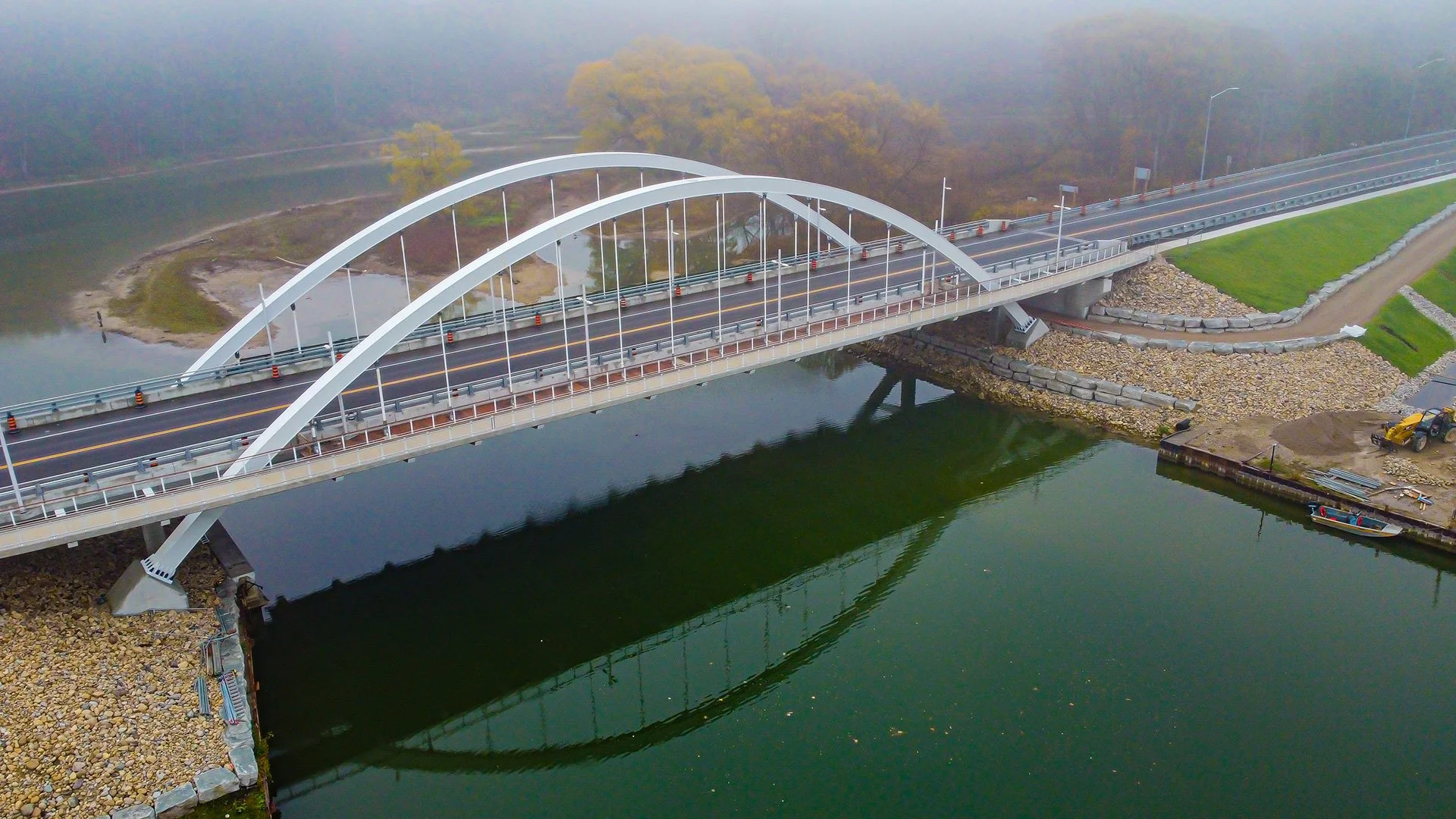
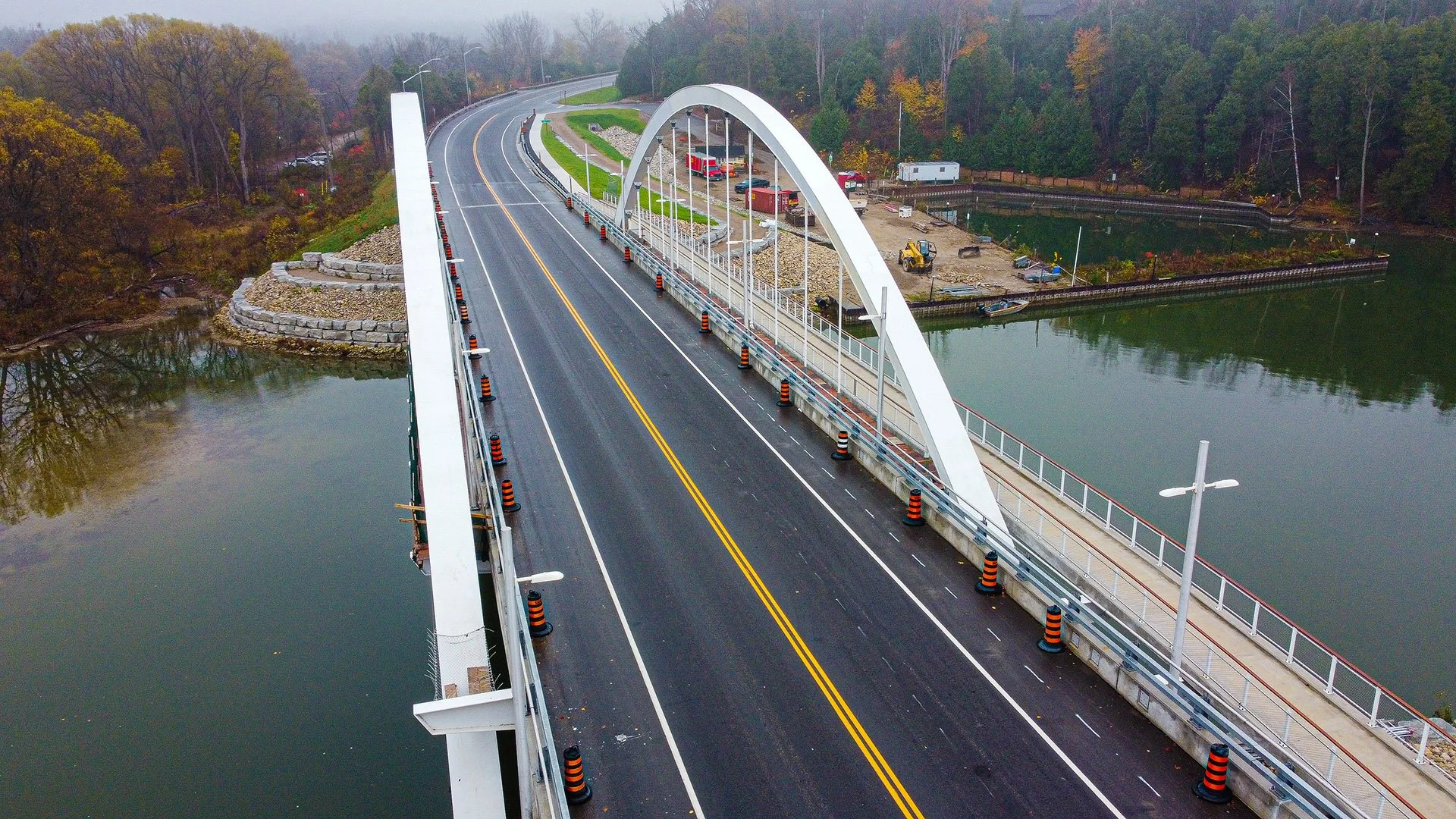
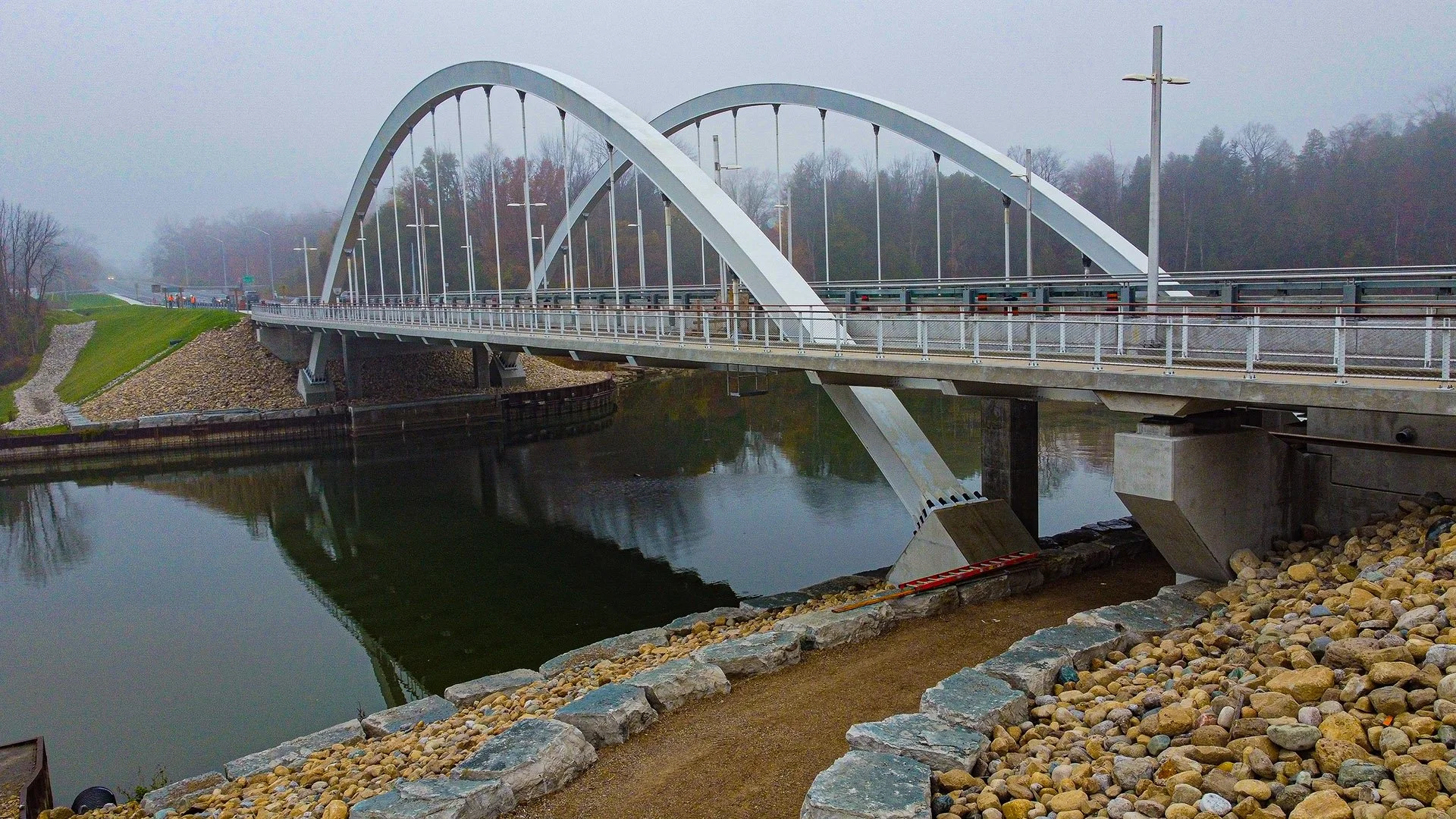
In total, the project involved the removal of the two-span steel deck truss built in 1949 and the construction of a twin-rib cable-supported freestanding steel arch bridge along Highway 21.
Bridge Details
The new bridge is configured with short 8 m end spans between piers and abutments, and a main arch span of 70 m (between piers) spanning the Bayfield River. The deck grillage is supported from the arch (within the arch span) by a series of steel multi-strand cable hangers with clevis-type end connections.
Harbourside’s Scope of Work
Upon award, Harbourside was initially contracted to provide erection engineering and construction engineering services in support of the Bayfield Bridge replacement. Throughout the course of the project, the primary scope was extended to included additional components. The overall scope of services provided included:
Superstructure Steel Erection
Cable Hanger Erection
FEA Model Development and Calibration
Hanger Length/Tuning Development
Cable Hanger Shop Assembly Quality Verification Engineering (QVE)
Cable Hanger Erection QVE
Thrust Block PT Anchorage Stressing Procedures
Thrust Block PT Anchorage Stressing QVE
Screed Determination and Deck Casting Sequence
Erection Methodology and Technical Elements
Unloading and Assembly of Arch Segments
The arch segments were first unloaded into the assembly area west of the existing Highway 21. Originally, the intent was to assemble the arches vertically on temporary towers. To reduce assembly time, costs, and the risks associated with 16-meter-high temporary towers, Harbourside proposed assembly of the arches on their side (horizontally). This would also simulate the trial assembly condition in the shop. The arch segments were unloaded onto temporary supports which were designed to allow for free thermal movement. In addition, the design was also made to accommodate geometric micro-adjustments as required during assembly.
Strongbacks (i.e. additional support components) located at the field splices were used to maintain the relative geometry established during the shop trial-assembly. The arch geometry was also continuously monitored by survey throughout the progressive welding operation.
Rotation, Hoisting and Geometry Control of Completed Arch Segments
In total, five cranes were used for the rotation and hoisting of the arches. To help with the initial rotation from horizontal to vertical, two smaller mobile “tailing” cranes were positioned at each end of the arch and used as “hinge points”. The “main” crane used for the primary rotation and to lift into final position was positioned behind the South Abutment. The last two smaller cranes were used for loading and unloading counterweight. These last were also used for man-baskets for the iron workers. Once the arch was in the vertical position, it was transferred from the “tailing” cranes to the “main” crane.
One of the main challenges of erecting the arches was controlling their geometry to ensure the base plate would align with the anchoring system. Conventional rigging turned out to be challenging to control the geometry as well as maintain the arch stability, so an alternative method was used. Instead of a “bowstring” type assembly, Harbourside incorporated in-line long-stroke hydraulic cylinders with each strategically placed rigging line.
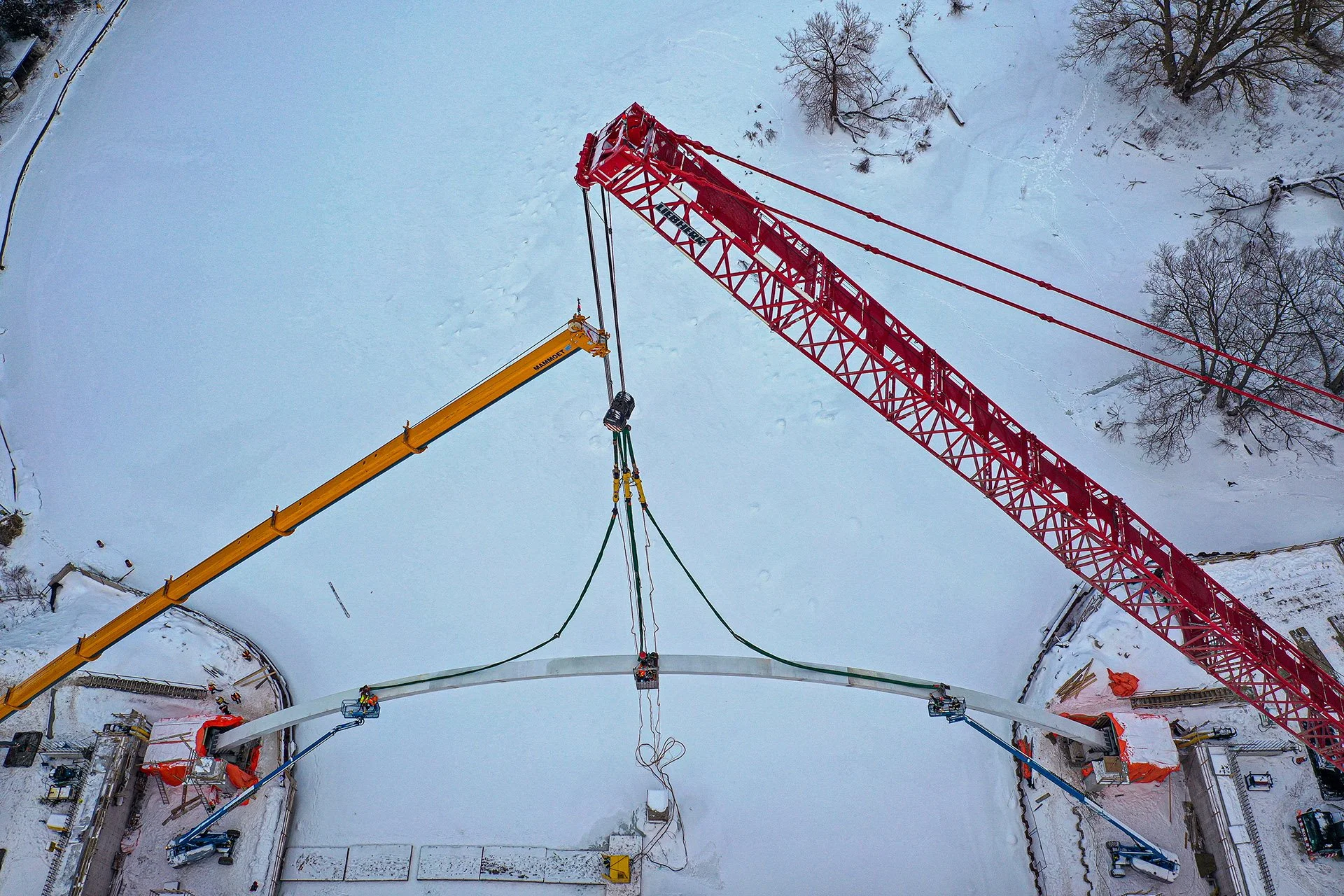
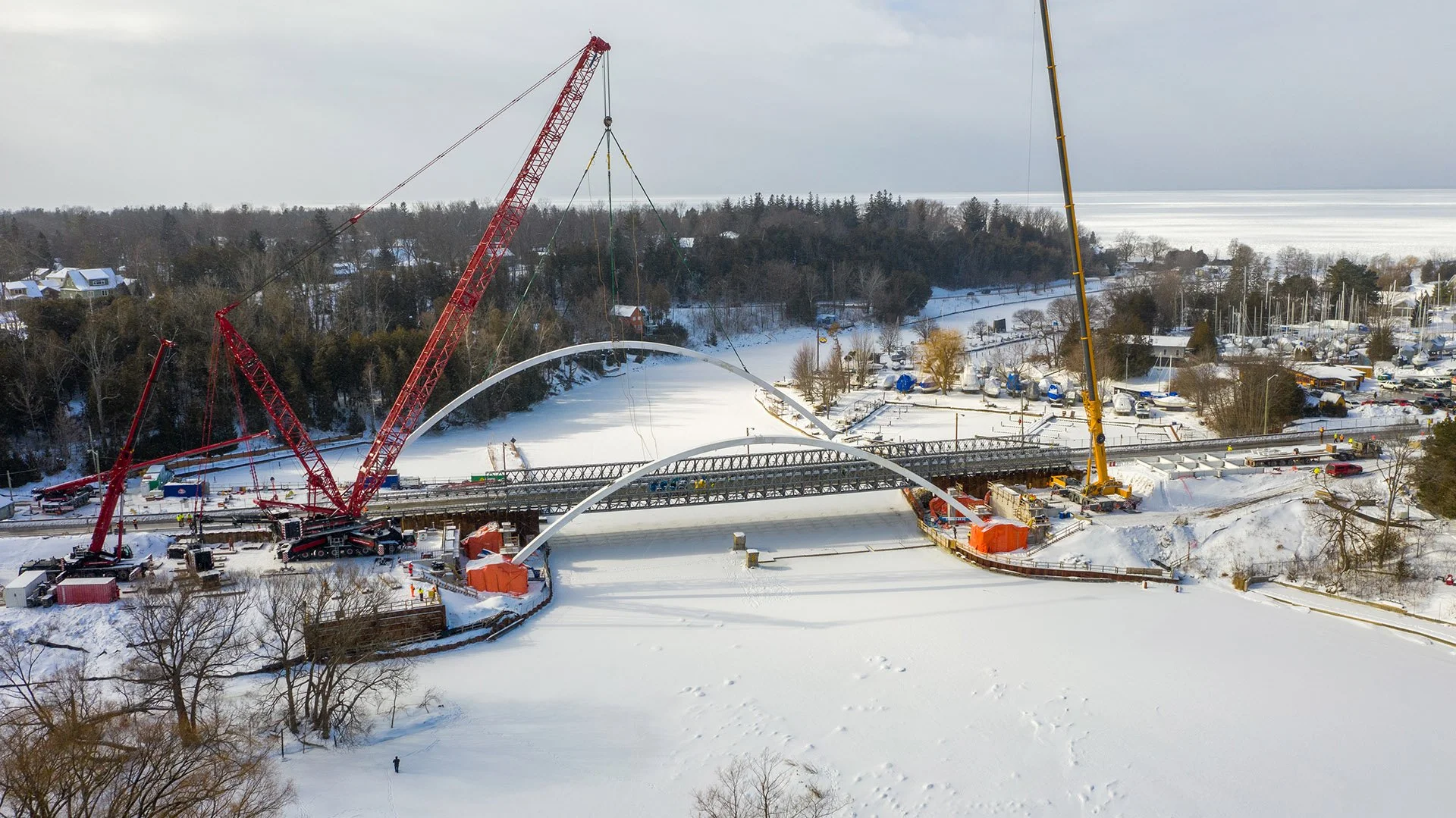
This allowed for instantaneous adjustment to the arch profile while also monitoring the loads in each rigging line. Doing so ensured that the arches remained elastic during the entire process. Then, the arches were installed on the thrust block anchorages and brought to a snug tight condition. The only temporary supports used to support the free-standing arches were jacking corbels anchored to the face of the thrust blocks. The corbels were equipped with threaded rod “set screws” to allow for re-positioning of the arch base plate above the post-tensioning rods. Once the base plate was in the correct position, the Contractor completed a live survey of the arch to confirm arch position and verticality.
Due to the tight tolerance with both arch position and verticality, Harbourside incorporated a modified design that replaced shim plates between the thrust blocks and arch base plates with threaded rods countersunk into the underside of the arch base plate. This allowed for micro-adjustments to the threaded rods while the arch was suspended over the thrust blocks.
PT Stressing Procedure
Once the arches were in their final positions, bedding grout was placed between the base plate and thrust block. After the bedding grout achieved required strength, Capitol Steel proceeded with the PT stressing procedure designed by Harbourside. When desired loads were achieved, the arches were re-surveyed to confirm geometry and the PT ducts were grouted.
Cable Hanger Installation Procedure
Cable hangers were assembled in the Capitol Steel fabrication shop in accordance with the manufacturer’s procedures. Harbourside provided full time Quality Verification Engineering in the shop.
Using FEA Modelling, theoretical hanger lengths were established and used to fabricate the hangers. This was performed by Harbourside on the as-designed bridge structure. Furthermore, surveying of the as-built arch and deck steel during trial assembly minimized any further adjustments that would be required in the field. Hangers were transported to site in protective strongbacks which were then used to erect the hangers and prevent bending and overstressing during hoisting operations.
Deck Steel Installation Procedure
Once the hangers were installed on the arch, the deck steel was progressively installed from both the North and South approaches. Deck surveys were completed during progressive assembly at various steel temperatures. Adjustments to the deck steel elevations were completed “on-the-fly”, such that minor or no hanger adjustments were required following erection.
Deck Screeds Development and Deck Casting Procedure
Deck screeds and an in-depth concrete casting sequence were developed using the FEA models Harbourside developed for the hanger length determination. The final procedure ensured that sufficient concrete was placed in advance of the standard screed machine. This enabled interim transverse floorbeam deflections to be realized and avoided the use of a complex automatic screed machine and process. Harbourside was present on site to witness the dry run and pour both completed successfully.
Final Cable Hanger Lift-Off Tests
Following completion of the deck, barriers and asphalt, lift-off tests of the hangers were completed to confirm the as-built dead loads in each hanger. Harbourside was responsible for the design of the stressing frame, the lift-off test procedure and monitoring of the procedure (QVE). This work was completed in 2021.
Sidewalk Extension Installation
Following removal of the temporary detour structure, located west of the new structure, the floorbeam extensions were installed, and the sidewalk cast. This required determination of screed elevations by Harbourside, and completion of final hanger lift-off tests once the full structure was completed. This was completed in 2022.
Social Impact
The Bayfield River Bridge has been an integral crossing for over 150 years. Although Bayfield is a relatively small community, the bridge has served its population since the town was founded. Many iterations of the structure have been built over the years, and its importance to those travelling along Highway 21 cannot be understated. This latest arch bridge is both visually striking and comes with the promise of a long service life for travellers crossing the Bayfield River.