

Etobicoke Creek Rail Bridge Replacement
Location: Etobicoke, ON
Client: Construction Demathieu & Bard, Metrolinx
Timeframe: 2025-2026
Key Personnel: Wade Pottie, Calvin MacAulay
Etobicoke Rail Bridge Replacement Summary
Harbourside Engineering was retained by Construction Demathieu & Bard (CDB) to design a versatile, modular gantry system to accelerate the span replacement of Metrolinx’s over 100-year-old Etobicoke Creek rail bridge located on Toronto’s Lakeshore West corridor, one of the busiest rail corridors in Canada. The gantry enabled the safe replacement of six bridge spans during three short (51-hour) weekend closures. This innovative approach minimized disruptions to commuters while avoiding the environmental impacts of traditional crane-based replacement methods.
Project Highlights
Innovation
When CDB engaged Harbourside to design a modular, gantry-based system for rapid bridge removal and replacement, the immediate need was driven by two upcoming projects—each with different access constraints and operational requirements. The first real-world test of this equipment occurred on the Etobicoke Creek Rail Bridge Replacement project, critical infrastructure of Metrolinx’s Lakeshore West line modernization program. On this site, CDB, acting as the prime contractor for Metrolinx, was tasked with replacing the bridge superstructure. The two span bridge carries three active rail tracks consisting of six individual superstructure segments - all within a dense rail corridor with limited available shutdown windows.
To support both the Etobicoke Creek project and future rail bridge replacements, Harbourside engineered a fully articulating gantry system that can adjust spans in six degrees of freedom (lift/lower, move both longitudinally and transversely, and rotate about all three axes). Vertical movements are controlled by strand jacks, longitudinal movements by motors within the a-frames, and transverse movements with two-way hydraulic cylinders.
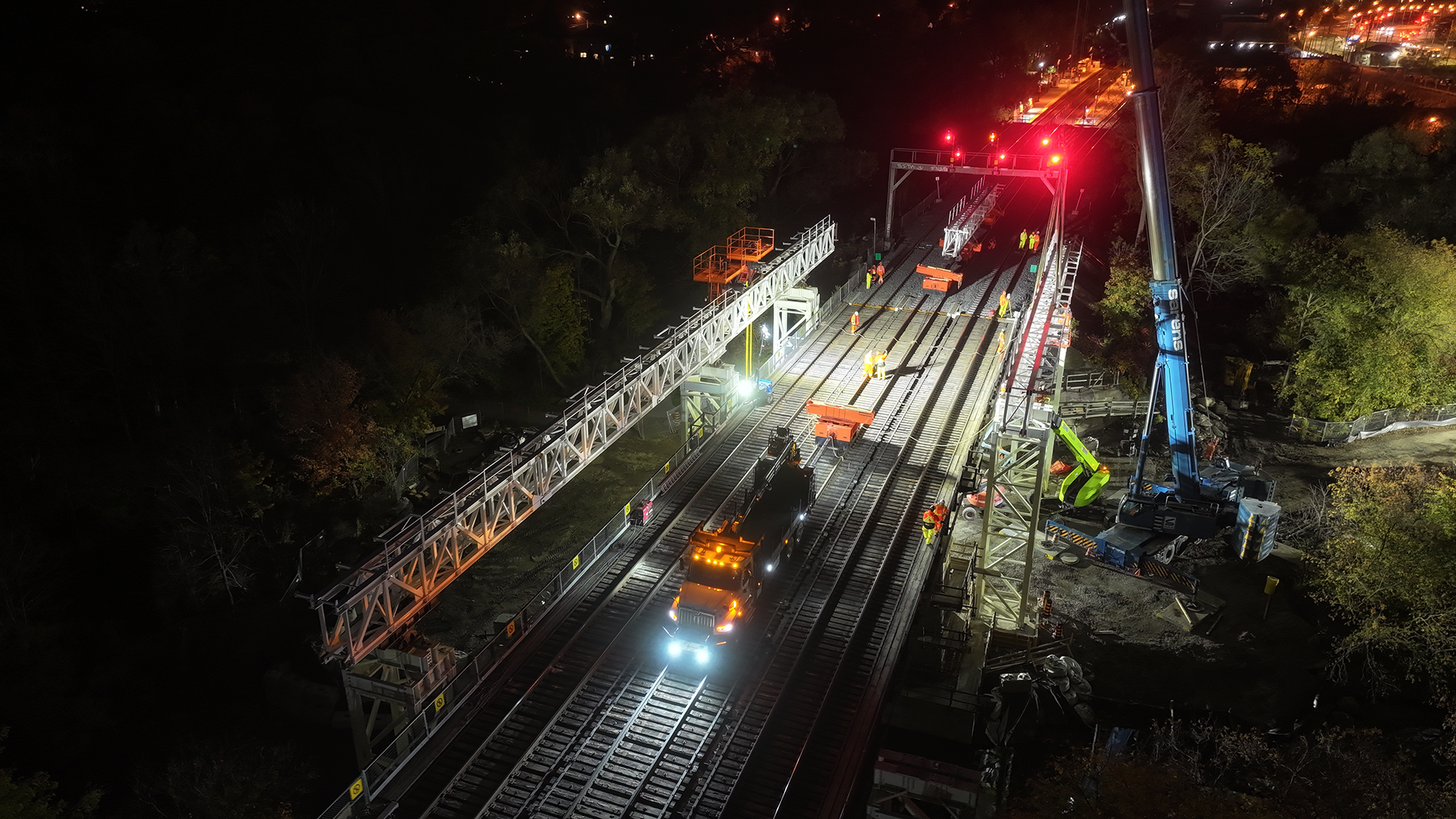
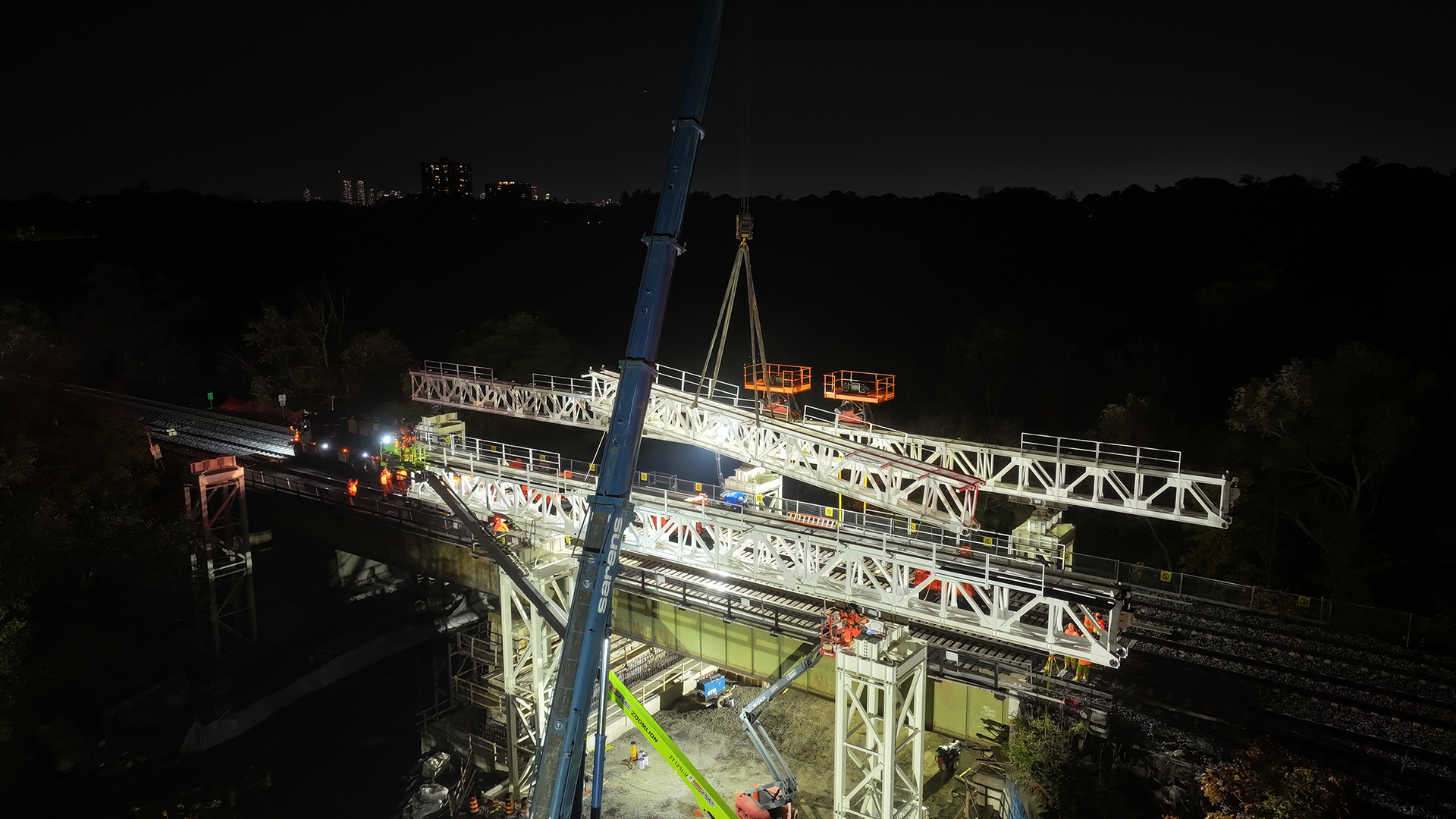
The gantry operates in two distinct modes: single-track and multi-track. Dual configuration enables the gantry to adapt to a broad range of bridge configurations and site constraints.
In single-track mode, the gantry operates directly from the existing rail, with the ability to remove and replace spans weighing up to 150 mT. In this configuration, the gantry has telescopic columns that transfer load from the rail down to the existing bridge deck. Its most innovative feature is the ability to fold compactly within a standard railway clearance envelope, allowing it to travel along a rail corridor (with adjacent tracks operational) to reach difficult-to-access sites. This reduces the logistical/environmental footprint, avoids the need for additional access, and enables highly efficient mobilization.
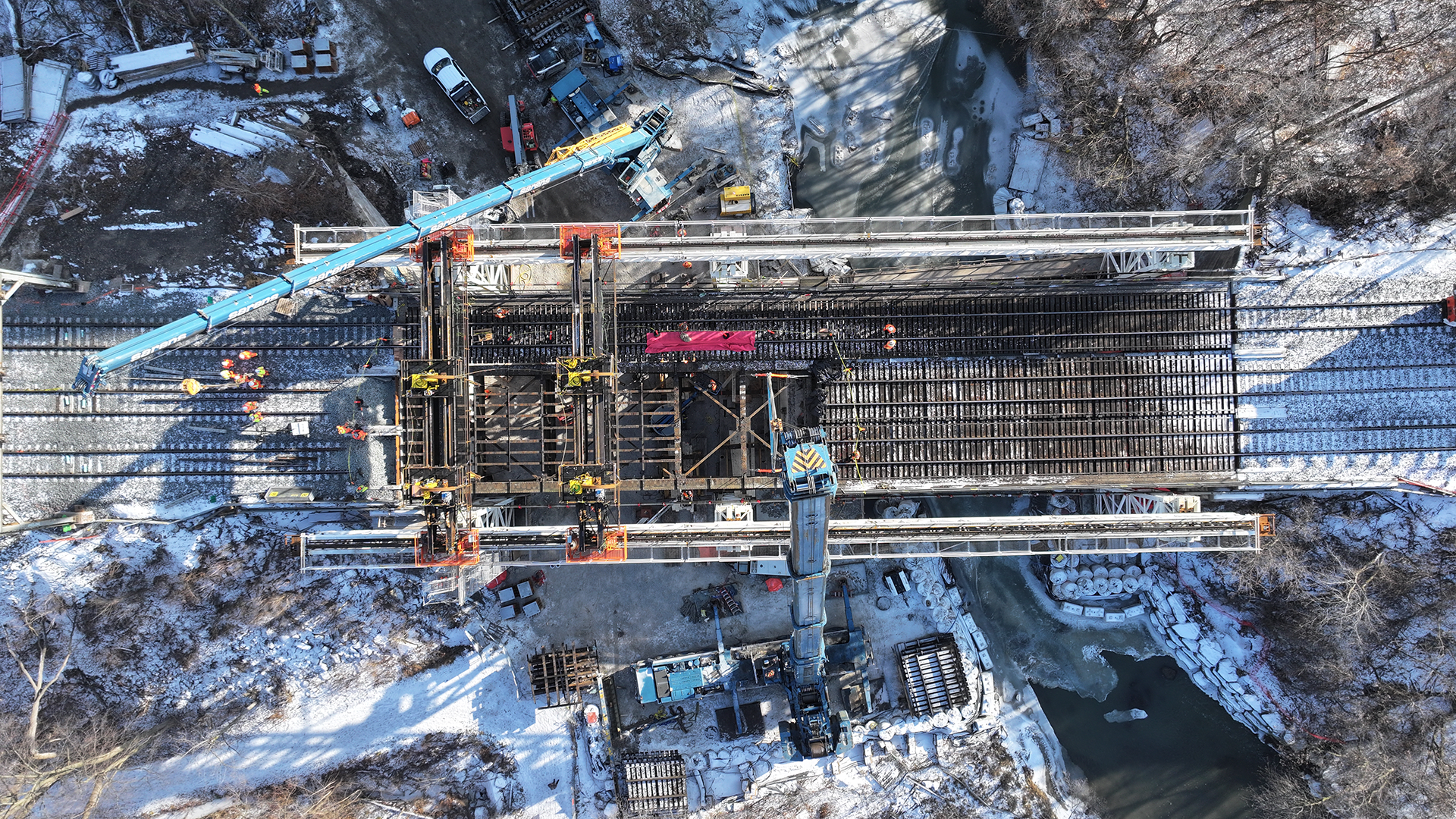
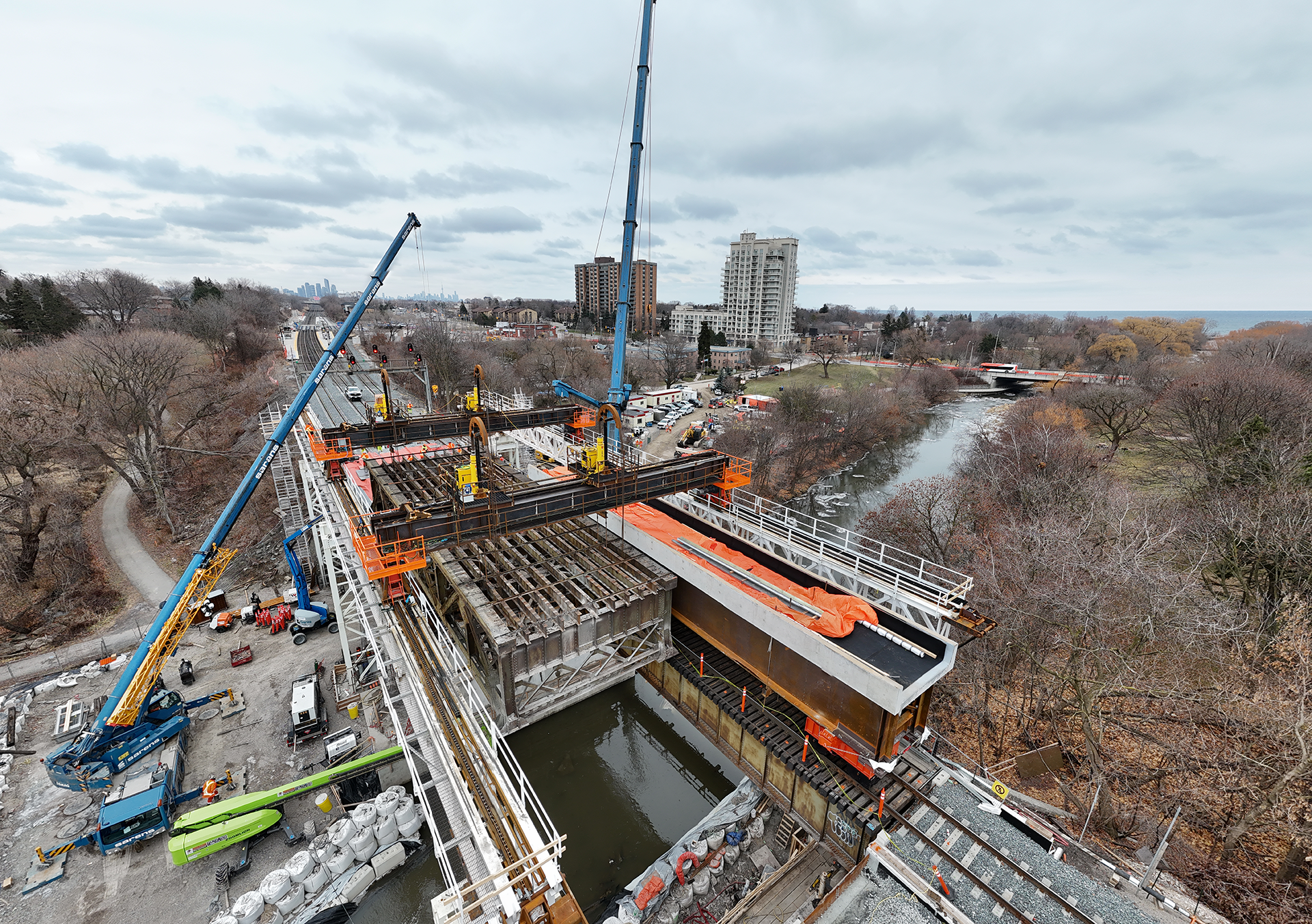
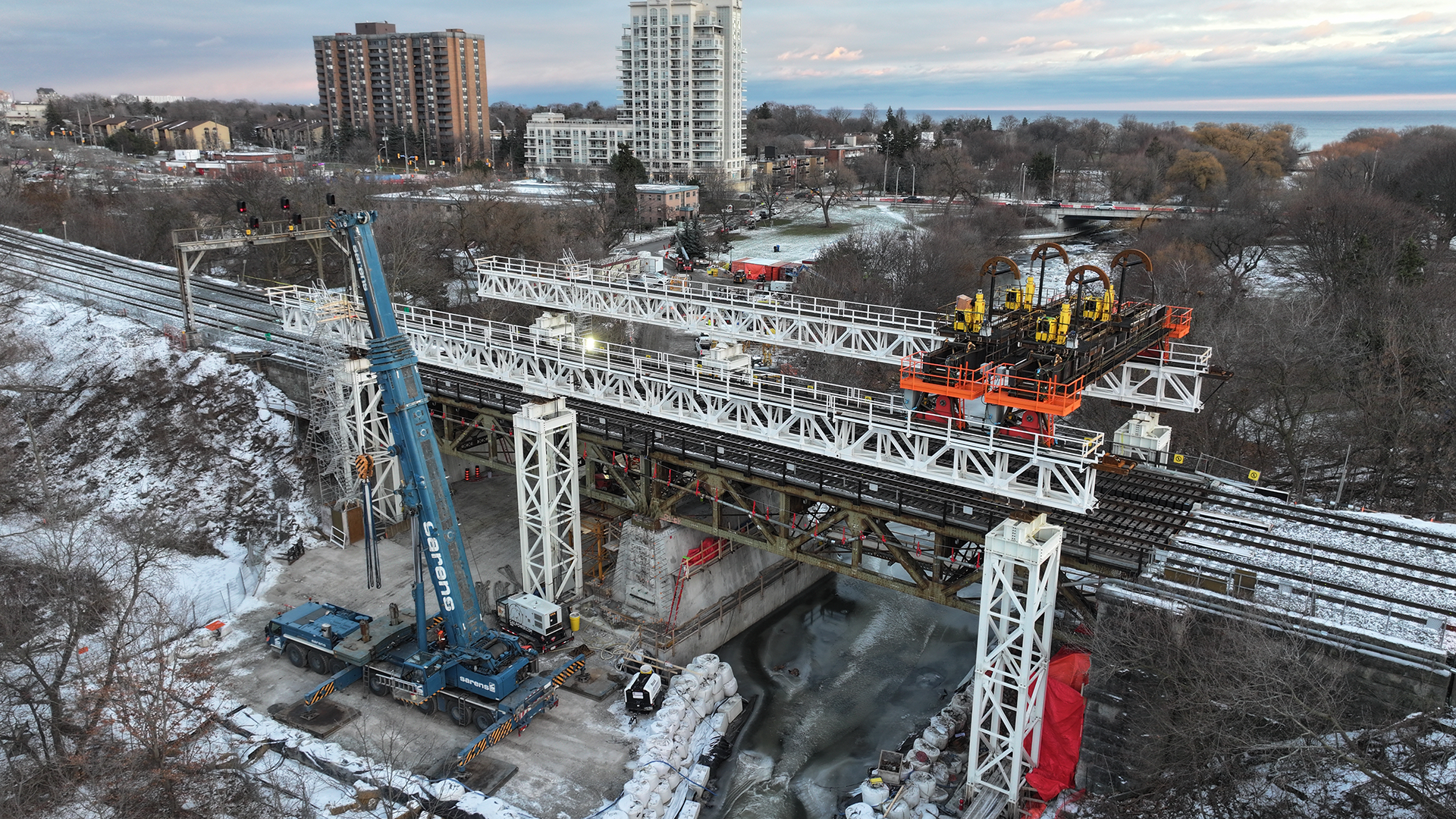
In multi-track mode, as successfully used in Etobicoke, the gantry is supported on modular towers (also designed by Harbourside) that flank the bridge structure, increasing its capacity to 210 mT and permitting work on structures up to three tracks wide.
What distinguishes this system is its modularity, giving it the ability to switch between configurations to suit site needs, allowing owners and contractors to deploy one system rather than multiple specialized solutions. This offers a unique and versatile approach rail-based bridge-replacement work in Canada.
The gantry system demonstrates a novel integration of modular design, structural engineering, and construction staging—providing a safer, more flexible, and highly repeatable method for accelerated rail bridge replacement across varied site conditions.
Complexity
Designing two distinct operational modes, single-track and multi-track, introduced a high level of complexity. Both modes required their own lifting geometry, load paths, and assembly sequence, using the same set of modular components. Each piece of the system was specifically designed to be transported in standard shipping containers, handled safely on-site, and quickly/easily assembled, mostly with pinned connections. This could all be done within the limited space available on congested urban rail corridors.
Stability of the gantry during operation in single-track mode was an extreme challenge, as the gantry system is tall and slender relative to its telescoping columns (support points) on the bridge girders. Harbourside ensured stability by implementing operational wind limits during replacement operations and by designing innovative uplift restraints to prevent instability resulting from imbalanced loading.
Smooth operation of the gantry required substantially tighter design and construction tolerances than would typically be used in structural design applications. Furthermore, several operational constraints, such as tilt, list, skew, load differential, were implemented into the design.
Load distribution among the four lifting strand jacks during lifting and operation was a critical design consideration. The statically indeterminate nature of the lift, combined with the torsional stiffness of the structure and the differential stiffness introduced by the bridge’s skewed bearings, created a highly complex load-sharing condition requiring careful analysis and control.
A further layer of complexity was automation. Omnifab were engaged by CDB to design the mechanical/electrical components of the gantries. The gantry’s controls allow two operators to manage all gantry movements.
Social and Economic Impact
The greatest social and economic benefit of the gantry was the speed by which it could safely replace the rail bridge spans. From gantry erection through to gantry removal, and with the Contractor operating under an accelerated construction schedule, the full operation took less than three months. The replacement of the spans themselves was completed during only three weekend closures in that period.
Even without the World Series, the Lakeshore West line is the busiest corridor in Metrolinx’s network, carrying approximately 33,500 passengers each weekday*. Every trip depends on a fully operational rail system. Even brief closures cause far-reaching consequences—disrupting employment, delaying critical appointments, interrupting supply chains, and impacting time-sensitive business operations. The economic and social effects across the GTA are significant and difficult to quantify. Shutdowns require complex replacement services, straining transit resources and coordination. Passengers without viable alternatives shift to less efficient travel modes, increasing congestion, extending commute times, and compounding disruptions for residents, businesses, and the regional transportation network.
Traditional crane-based replacement methods would not have been feasible while reliably adhering to the construction schedule. Site constraints and lower operational wind-limits would mean greater risk of cancellations due to weather. Even a minor delay in reopening would gravely impact transit for Toronto’s commuters.
Harbourside approached the project from a solution-focused mindset. The innovative gantry design allowed for maximize usage of closures, removing the spans along the bridge rapidly and without fear of winter weather. All this was completed while operating within the limited site constraints.
Environmental Impact
Naturally, ensuring access to reliable commuter rail has major environmental impacts. As the busiest Metrolinx line, Lakeshore West counted a ridership of over 500k from 2020 to 2021*. Five-hundred-thousand trips that were made by train instead of car. At over a century old, replacing the Etobicoke bridge modernizes rail infrastructure and ensures it remains operational for years to come.
The story does not end there, however. Construction over water has its own environmental implications, all of which were avoided by using the gantry. No infilling was required, and there was limited in-water work, minimizing environmental impact. The footprint of the gantry fit well within a pre-constructed cofferdam and thereby prevented the need for additional disruption to aquatic ecosystems. For future use in single-track mode, there are no temporary towers or other temporary works required. The gantry system is fully supported on the existing rail line, negating any environmental disturbance.
A notable advantage of the Gantry is its ability to replace bridge spans whole in a non-destructive fashion. When combined with its modular design, allowing it to be used on a variety of rail-bridges with different spatial constraints, the Gantry becomes a powerful tool for recycling. Structures can be removed, refurbished and reused in locations with reduced loading requirements. This limits scrap-waste, and the need for disposal.
Furthermore, the modularity of the gantry and its ability to be reused countless times for bridge span replacements in the future negates the need for the fabrication of temporary works on future projects.
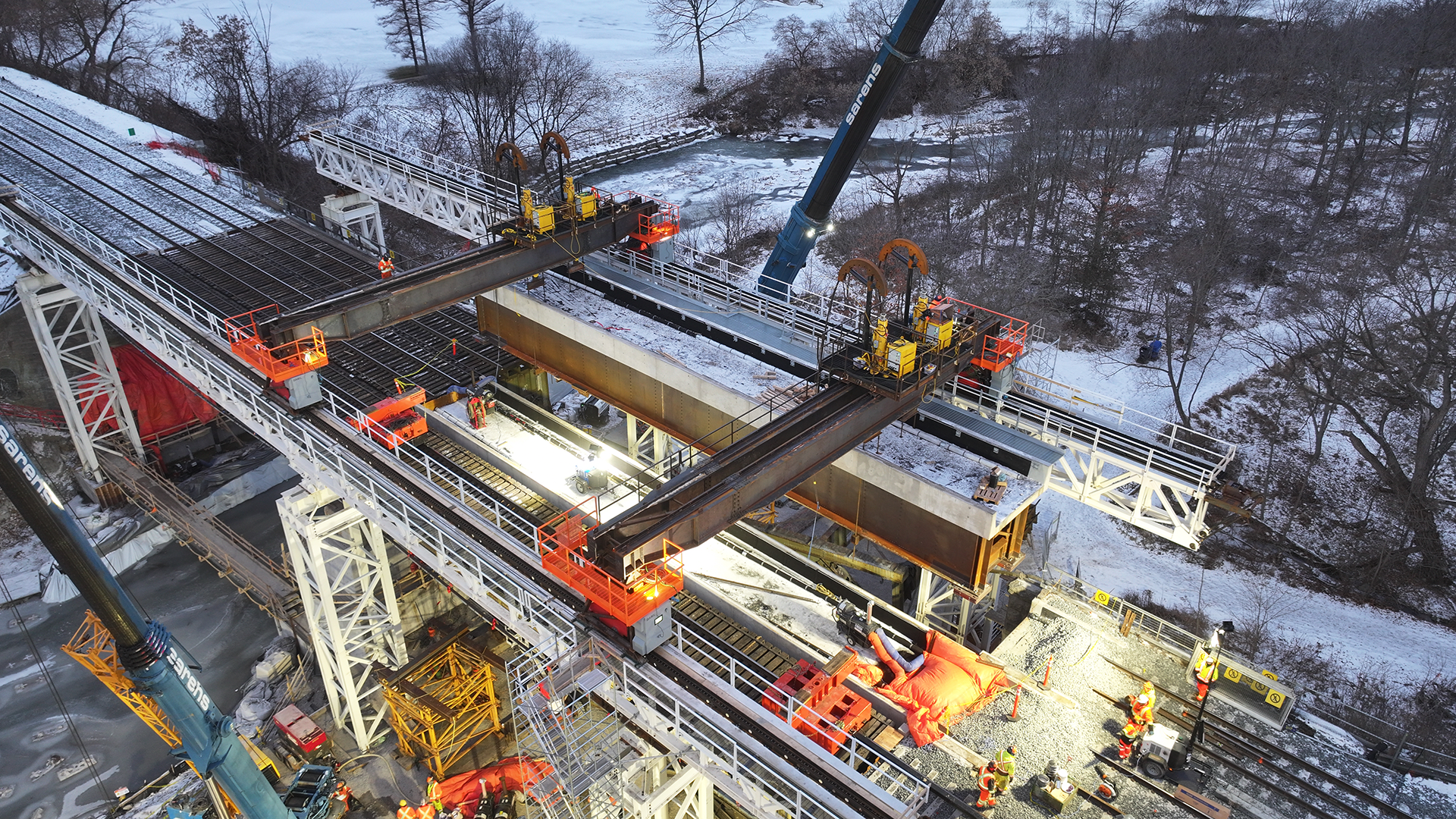
Workers on site assembling the gantry during the Etobicoke Rail bridge replacement. A crane lifts the header beam of the gantry into position. This image was originally shared by Metrolinx via LinkedIn.
Client Expectations
“To replace the Etobicoke Rail Bridge with as little impact on transit as possible.”
This was the goal Metrolinx set when hiring CDB, and was passed on to Harbourside. Span replacement had to be completed within three limited weekend (51-hour) closure windows. No easy task, given the age of the structure. Together, this partnership developed a tool to complete the work safely, and faster than traditional methods. Even with a postponed closure due to The World Series, the gantry used at the Etobicoke Rail Bridge allowed the project to be completed within the allotted timeframe.
Thanks to this, Lakeshore West, Toronto’s busiest rail line, could keep rolling on schedule. Knowing that further rail-line improvements would be necessary beyond Etobicoke, the gantry was designed to be modular from conception. Useable across multiple different configurations, the success achieved on first use was a proving ground for future projects. Now, rather than relying on traditional bridge replacement methods, Metrolinx will be able to use Harbourside/CDB’s gantry to expedite future rail bridge replacements.
This type of forward-thinking ensured that Metrolinx received the highest calibre of engineering design and the greatest value for their investment in consulting. Harbourside and CDB saw beyond Metrolinx’s immediate need and planned for future rail-line improvements. The issue facing these projects was efficiency, so what better way to serve the client than to solve multiple bridge replacements using a single tool?
Notably, the gantry is scheduled to be deployed during the upcoming Kapuskasing bridge replacement this summer in northern Ontario.