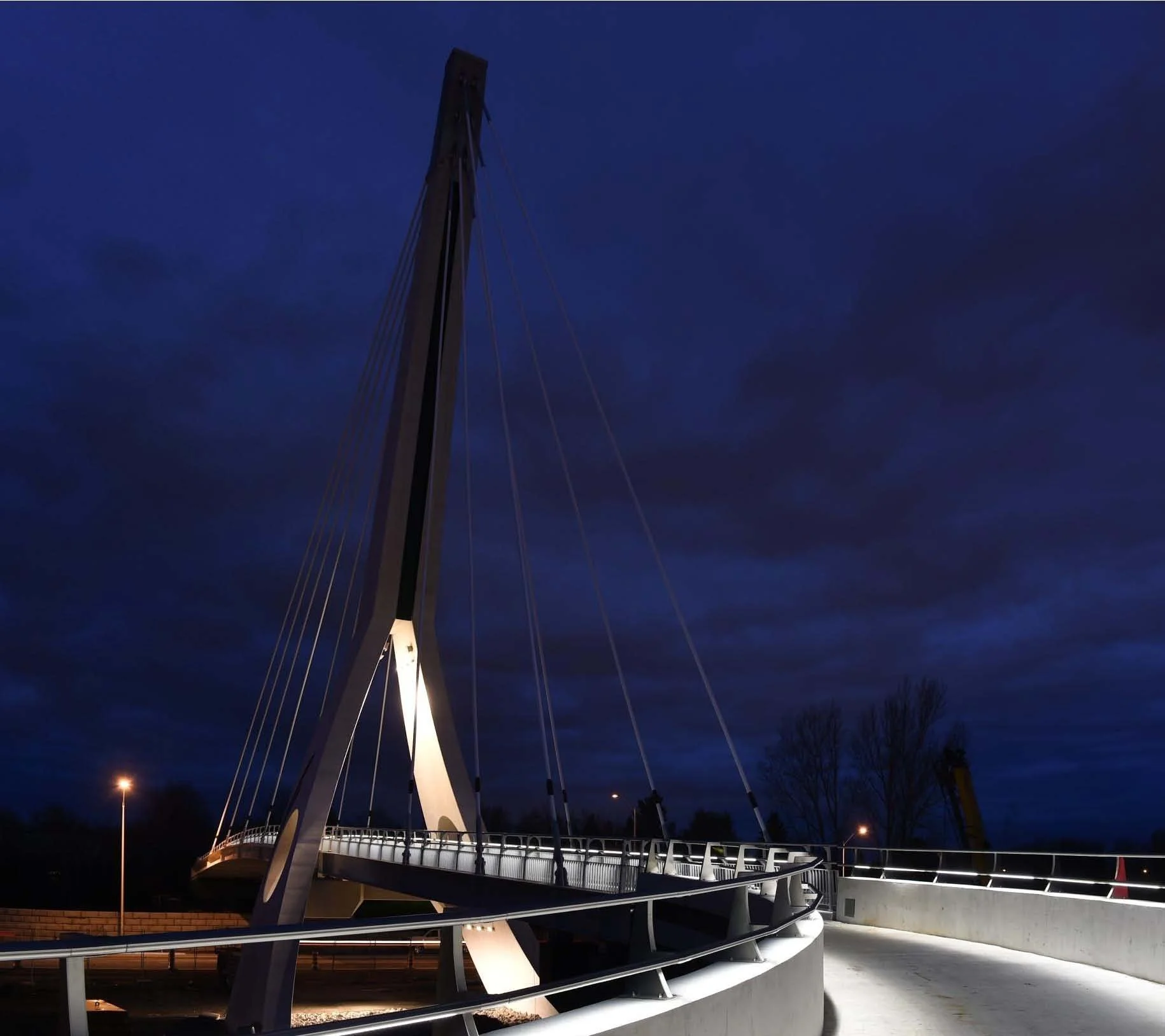

Juno Beach Memorial Pedestrian Bridge Erection
Location: Ottawa, Ontario
Client: Louis W. Bray Construction Ltd.
Timeframe: 2014
Key Staff: Doug Power, Robbie Fraser
UPDATE:

In 2016, Harbourside PEI was awarded the Lieutenant Governor’s Award for Engineering Excellence for work on the Juno Beach Memorial Bridge Erection.
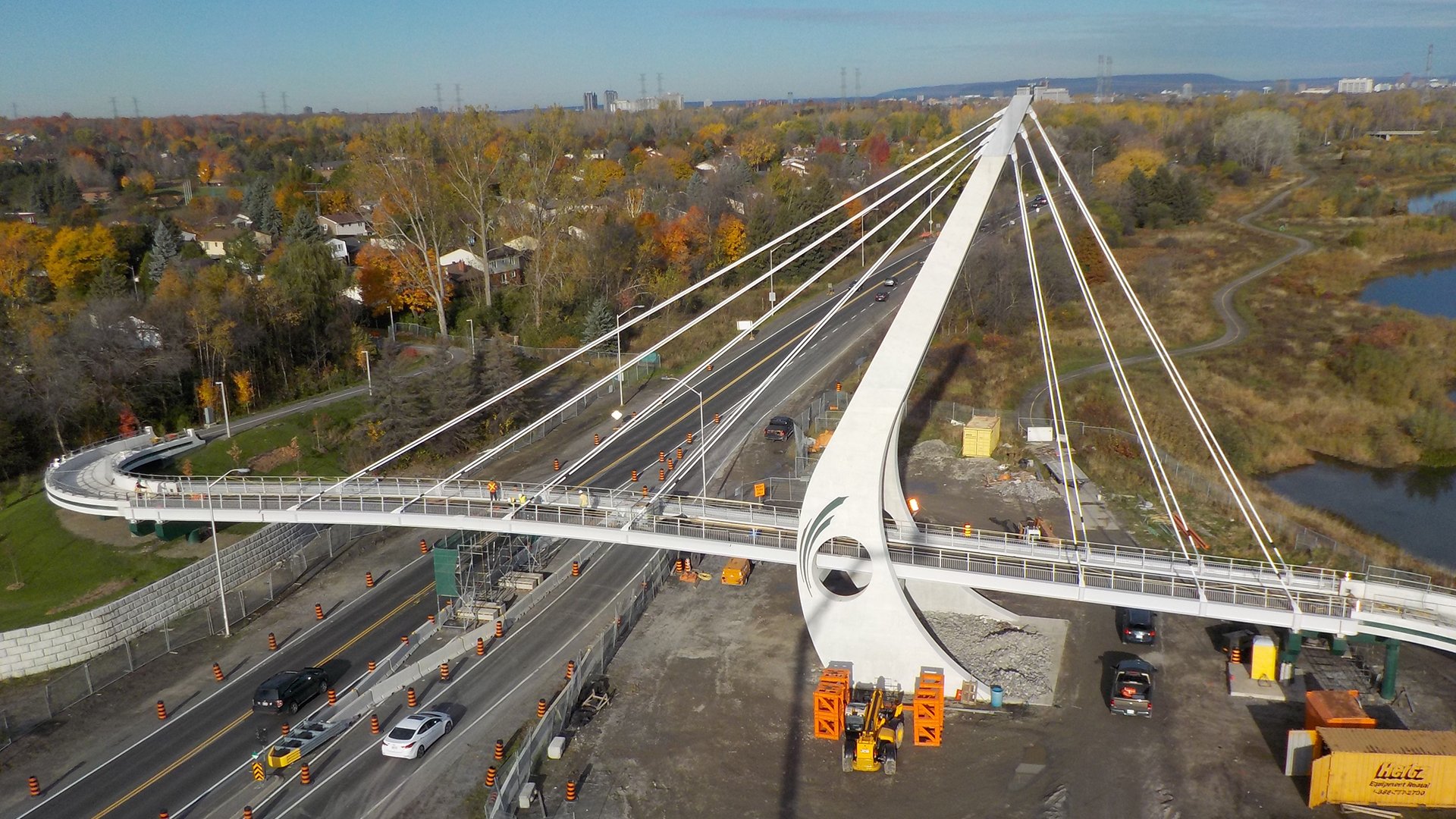
The Juno Beach Memorial Pedestrian Bridge (Formerly known as the Hunt Club Pedestrian bridge) is a cable-stayed pedestrian bridge with orthotropic steel plate deck spanning the Airport Parkway in Ottawa, ON.
Prior to its construction, pedestrians had to take a treacherous path to reach the South Keys. This involved moving across the Airport Parkway, and cross through a tunnel beneath the CNR rail line. This was dangerous, and resulted in pedestrian/vehicle collisions on more than one occasion. This was exacerbated with the South Keys shopping center having no adequate pedestrian access. Plans for a pedestrian route were developed as early as 1994 but had to be re-developed with the construction of the Sawmill Creek Wetland. A pedestrian fatality in 2007 prompted swift action, and by 2011, construction had begun on what would become the Juno Beach Memorial bridge.
Harbourside’s Role
Harbourside was added to the project team as erection specialists when the redesign was near completion. Originally designed by another firm, multiple setbacks prompted the City of Ottawa to dismiss the original designer and retain Parsons to redesign the bridge. Given the impact of previous project delays, there was added emphasis completing the bridge quickly, while mitigating any risks to the remaining construction work.
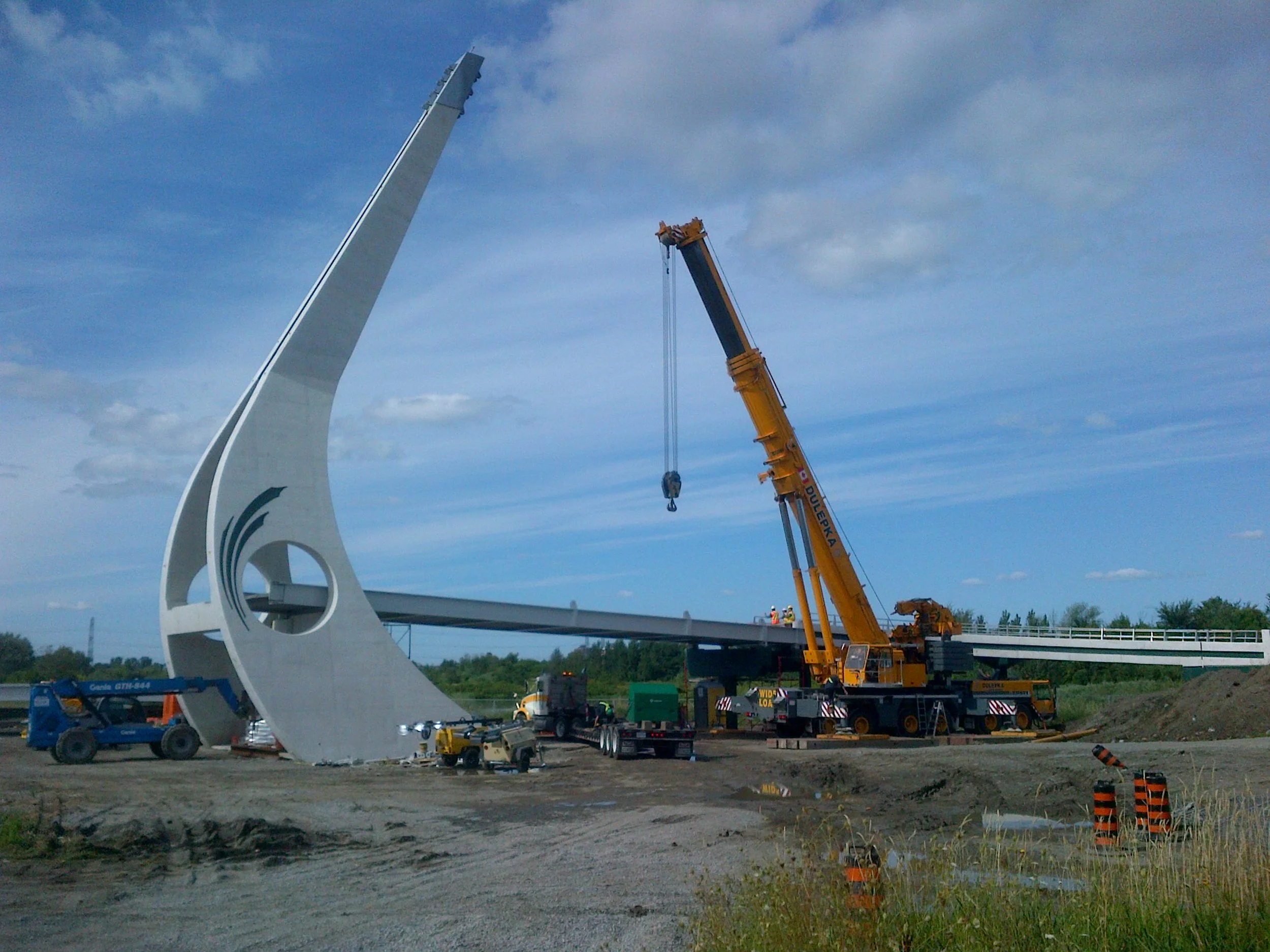
Harbourside were brought in as erection specialists to work with general contractor Louis W. Bray Construction in building the structure designed by Parsons. Harbourside’s scope of work included developing erection methods and alternatives, designing temporary works and traffic control measures, and participating in team project planning.
The beautifully unique design of the bridge required that Harbourside staff develop specialized geometry control procedures. This included laying our survey points on the bridge to monitor geometry throughout construction. A method was developed to position and survey the weldment located at the top of the tower. Temporary works were designed to fine-tune the weldment position before connecting it to the structure with cast-in-place concrete.
As part of the erection phasing, Harbourside developed scenarios and produced drawings showing crane and transporter locations for delivering and lifting decking segments. Careful attention was given to field splice bolting requirements in the temporary condition.
Using steel sections readily available in the fabricator’s stockpile, Harbourside designed a temporary bent to support the deck segments during installation and cable stressing. Harbourside also provided the design and layout of barriers and traffic control measures to protect the temporary bent in the event of a traffic collision.
Harbourside reviewed the erection scheme proposed by Parsons, performed calculations and prepared drawings giving the catenary profiles of the stay cables. The sensitivity of cable installation forces to ambient temperature was also assessed. Harbourside engineers prepared erection sequence drawings outlining the installation of stay cables and removal of temporary works.
Social and Environmental Impact
One of the key components to the Juno Beach Memorial bridge erection was that it needed to impact the constructed wetlands as little as possible. This ecologically significant area exists to improve water quality and provide recreational green space. It plays an important role in biodiversity, so any disturbances had to be kept to a minimum.
Beyond the green construction of the bridge, the structure itself provides more complete modes of transportation for the city of Ottawa. The Juno Beach Memorial bridge connects two key areas that were otherwise difficult to access. Now pedestrians and cyclists alike can travel in safety by means of this beautiful structure.