

Location: Newfoundland and Labrador, Canada
Client: Newfoundland and Labrador Department of Transportation and Works (NLDTW)
Duration: 2015
Key Staff: Michael MacDonald, Robin King, Florence Allaire
Project Description
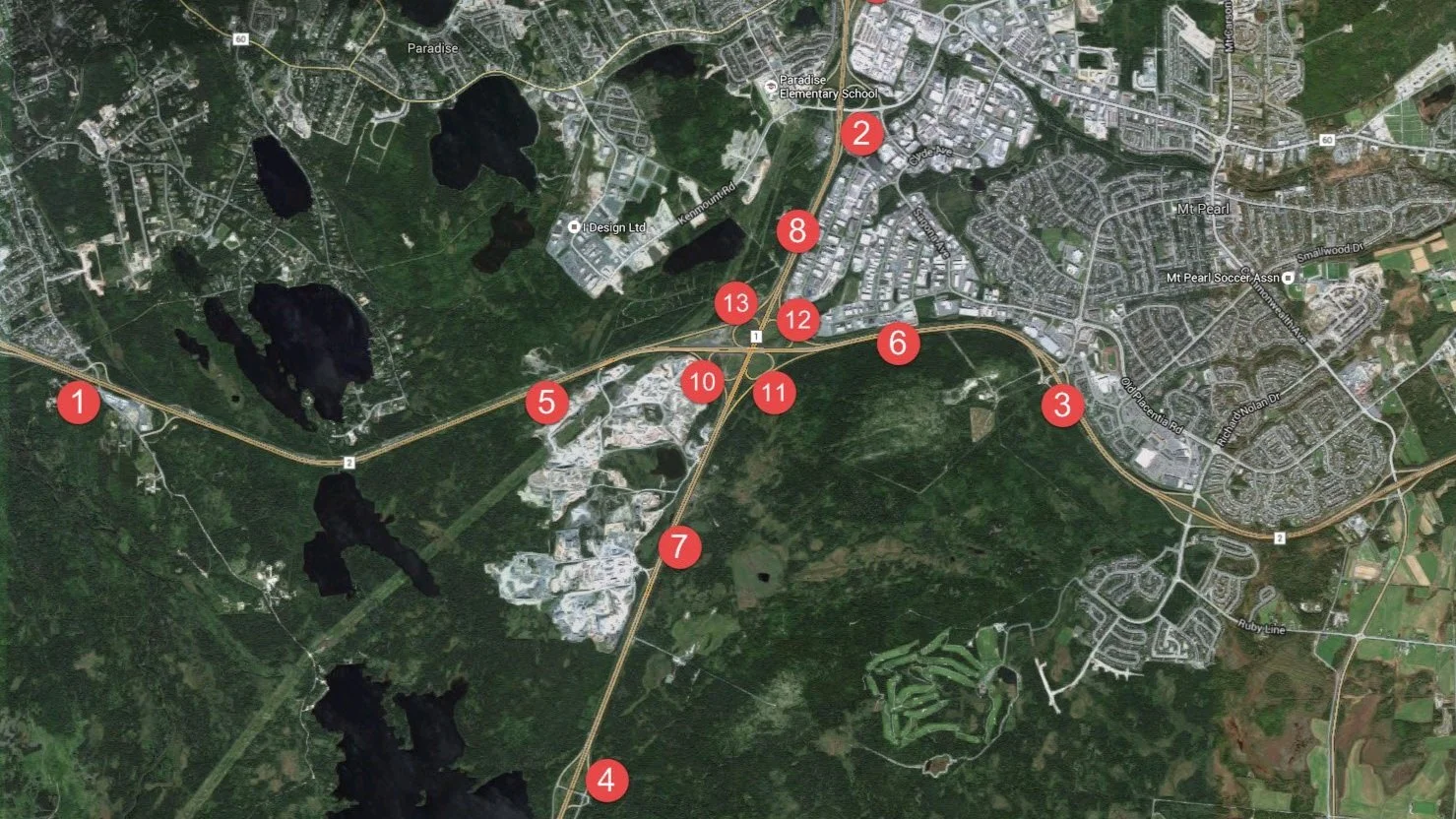
In 2015, Harbourside Transportation Consultants (HTC) were retained by the Newfoundland and Labrador Department of Transportation and Works (NLDTW) to study the potential impacts of a new interchange that was being proposed on Route 2 between the Route 1/Route 2 cloverleaf interchange and the Fowler’s Road interchange.
The interchange was being proposed for several reasons, some of which include:
To provide access to a new site that was being developed by Oceanex Inc.
To provide a connection from the Town of Paradise to Route 2
potentially accommodating a new roadway connection extending south to the Paddy’s Pond interchange
Harbourside’s Role
Trips generation rates were developed by Harbourside Transportation for the years 2020 and 2030 based on a series of stakeholder interviews with various municipalities and Oceanex Inc. The trips were entered as new zones in the City of St. John’s 2025 VISUM models, which was used to distribute the traffic associated with growth scenarios.
Harbourside Transportation Consultants tested several different configurations of the interchange under the traffic volumes associated with growth projections that were made to the years 2020 and 2030. In total, traffic volumes were obtained for fourteen (14) different analysis scenarios involving the AM and PM peak hour conditions, growth projections to the years 2020 and 2030, and four (4) different road network configurations.
The growth that was anticipated over the next fifteen (15) years in the Town of Conception Bay South, the Town of Paradise, the City of Mount Pearl and the City of St. John’s was expected to have significant implications on the NLDTW transportation infrastructure in the study area. Without any improvements in place, the vast majority of Route 1 and Route 2 freeway segments in the study area would become heavily congested during both the AM and PM peak hours. Harbourside Transportation recommended improvement plans for both horizon timeframes. HTC also recommended that the NLDTW look at Transportation Demand Management (TDM) strategies to effectively reduce the anticipated traffic volumes to more manageable levels.